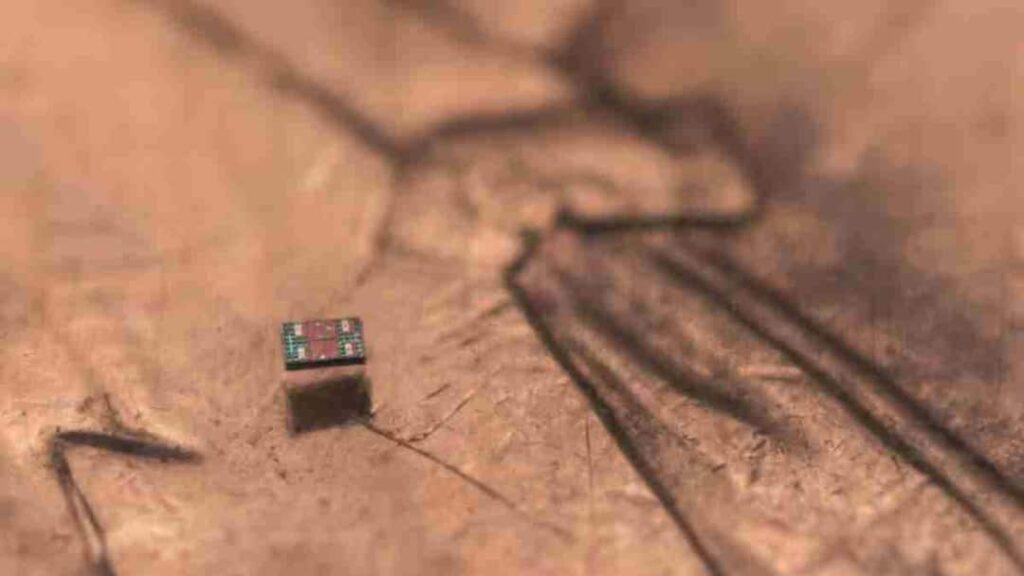

Smallest Robot: The tiny robots seen in science fiction movies are no longer just a fantasy. Scientists have created micro robots that are smaller than a grain of salt but can still think, understand their surroundings and move on their own while swimming in liquids. This technology is considered to be a big change in the world of robotics.
How small are these micro robots?
These unique robots have been jointly developed by researchers from America’s University of Pennsylvania and University of Michigan. Their size is about 200×300×50 micrometers i.e. many times smaller than the thickness of human hair. Despite being so small, these robots can sense changes in temperature, can walk on fixed paths and can continue working for months without any external help.
Unique light-powered technology
The most special thing about these micro robots is that they do not require any battery or motor. They take power entirely from light. The miniature solar cells present inside them convert light into energy. They do not use traditional wheels or legs to move, but instead propel themselves by giving a slight push to the ions i.e. electrically charged particles present in the liquid. According to the physical laws of the micro world, this method is considered to be the most effective.
ability to think and decide
Micro robots created earlier usually had to be controlled from outside, such as with the help of magnetic fields or wires. But these new robots are completely self-reliant. In these, the capabilities of sensing, computing, decision making and movement are present in a single small system. They can take decisions on their own according to their surrounding environment and can work without any human instructions.
can also communicate with each other
These micro robots can also communicate with each other through signals by making special patterns visible under the microscope. This means that in future these robots can form a team and complete any work, that too without any external control system.
Where will it be used in future?
The use of these robots can prove revolutionary in medical and scientific research. These can monitor biological processes at the cellular level, help in medical tests or be used in assembling extremely small electronic devices. Since they can be manufactured on a large scale at very low cost, new doors open for research and engineering.
Also read:
Press one button and the country goes offline! How do governments stop entire internet connectivity within minutes?