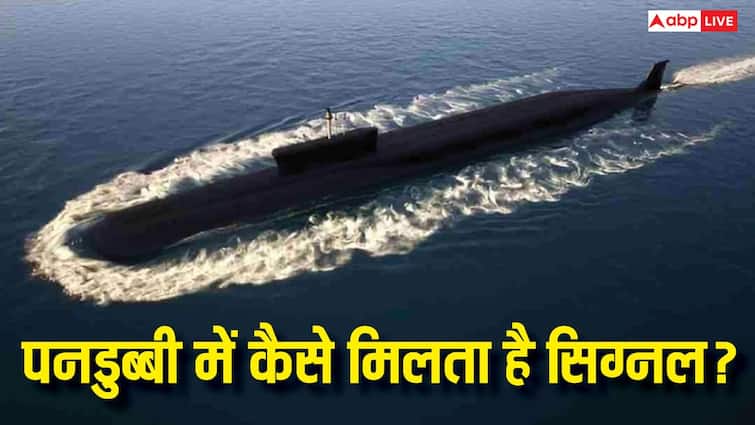

Signal in Submarines: The biggest question for a submarine deployed in the depths of the ocean is how to connect with the outside world, when water rapidly blocks radio waves? It is easy to receive signals above the surface but under water the situation becomes complicated. In this article we will explain in simple language how submarines communicate and which technology becomes the solution.
water and radio
Seawater, especially humid seawater, absorbs high-frequency radio waves very quickly. Due to this, Wi-Fi, cell phone or normal radio signals cannot reach deep. Therefore, for submarine communications, special wavelengths and alternative mediums are used, each of which has its own advantages and limitations.
ELF and VLF
The most widely used methods are Extremely Low Frequency (ELF) and Very Low Frequency (VLF) radio waves. These are very long waves that can penetrate some distance within the water surface. Low data messages (such as “surface” or “next command”) can be sent to the submarine via ELF/VLF. A major advantage of these waves is that they can reach some depth and can transmit messages without revealing the position of the submarine, but their data speed is very low.
Floating antennas and buoy receivers
When more data is needed, submarines sometimes deploy small floating antennas or buoys very close to the surface or at shallow depths. These antennas can remain on the surface and create a high-speed link with a satellite or ship while the submarine itself remains at a shallow depth. Similarly, some submarines snorkel and come up for a limited time and connect to the satellite.
Acoustic Communication and Sonar
Sound waves (acoustics) propagate better in water than radio. Therefore, submarines and surface vehicles communicate with each other through underwater phones, sonar and other acoustic systems. This method gives better range and higher signal speed, but it is also affected by noise and multipath effects and the data rate remains limited.
Optical and blue-green laser
In recent years, blue/green light penetrates better into water. Some research and laboratory-scale systems are trying to transfer high-speed data using lasers or light communication. But this is only suitable for clear water and short distances as turbidity and waves can quickly impair the signal.
Relay Networks and Modern Solutions
Modern solutions include unmanned surface services (USV) or drone-based relays, buoy-networks, and encrypted signaling protocols. These methods help in transmitting important data while maintaining the secrecy of the submarine. For security and stealth reasons, messages are often encrypted and limited information is sent in low-frequency signals.
Challenges and future
The main challenges in submarine communications are limited bandwidth, signal-absorption, noise, and the need to avoid detection. In the future, multi-mode communication (acoustic + optical + RF relay) and smart relay networks will further enable this field. Besides, quantum-sensor and advanced encryption will also increase security.
Underwater communication is not easy, but with the help of continuous development and smart technology, submarines are able to maintain continuous secure communication whether it is mixed system on the surface or short messages relying on ELF/VLF in depth.
Also read:
The habit of asking for charger from others can prove costly, expert makes shocking revelation